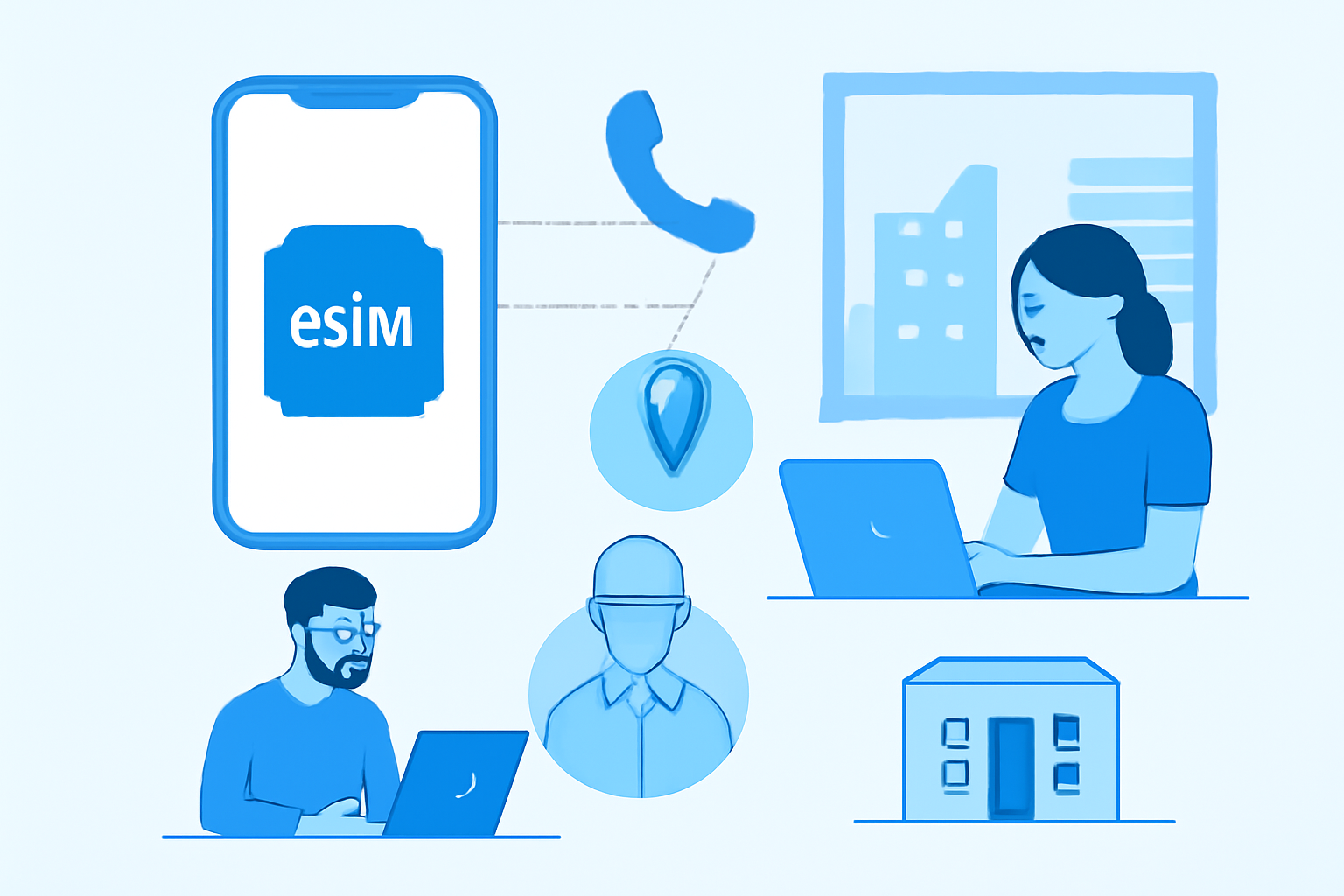
Modern businesses managing remote workers, field staff, and multiple office locations face a persistent challenge: how do you give everyone professional phone numbers without drowning in carrier contracts and physical devices? eSIM technology solves this by letting employees activate multiple business lines on existing smartphones, no physical SIM cards required. This approach works particularly well for small teams that need flexible communication but can’t justify complex PBX systems or dedicated business phones for every role.
What is eSIM Technology and Why Businesses Are Adopting It
An eSIM (embedded SIM) is a programmable chip built directly into modern smartphones and tablets. Instead of inserting a physical SIM card, you download a carrier profile digitally and activate a new phone number in minutes. The eSIM standard was developed by the GSMA and has been supported by major smartphone manufacturers since 2018.
For businesses, the practical advantage is immediate: your field technician in Manchester can add a local business line to their iPhone without visiting a shop or waiting for postal delivery. Your US-based remote worker traveling to Berlin activates a European number for client calls without swapping physical cards. Companies with seasonal staff can provision temporary numbers in bulk, then deactivate them when projects end.
The adoption curve has accelerated since 2021. Apple removed physical SIM trays from iPhone 14 models sold in North America, and Samsung, Google, and other manufacturers now ship eSIM-capable devices as standard. Most UK and European carriers support eSIM provisioning for business accounts, though some budget MVNOs still lag behind.
Virtual Phone Numbers vs Traditional Business Lines for Small Teams
Traditional business phone systems require physical infrastructure: desk phones, PBX boxes, or at minimum, dedicated mobile devices with SIM cards tied to specific hardware. When an employee leaves, you retrieve their device, swap the SIM, or deal with carrier support to port the number. For teams spread across cities or countries, this creates bottlenecks.
Virtual phone numbers through virtual phone number solutions operate differently. The number exists in software, routed through VoIP infrastructure or carrier APIs. When combined with eSIM technology, employees download a profile that links their device to your business account. The number belongs to your company, not the device.
This matters most for badge and ID card systems. When you print employee identification badges, you might include a contact number for facility security or visitor check-ins. With traditional systems, those numbers tie to specific desk phones or mobile contracts. If that employee moves departments or leaves, your printed badges become obsolete. Virtual numbers let you redirect calls without reprinting physical materials—route the badge contact number to the current duty manager’s eSIM line instead.
The quality difference has narrowed considerably. Five years ago, VoIP meant noticeable latency and dropped calls. Current eSIM implementations use LTE and 5G data with HD Voice codecs. For routine business calls, client meetings, and internal coordination, most users can’t distinguish between traditional cellular and eSIM virtual numbers.
Managing Multiple Business Numbers Without Multiple Physical Devices
The typical scenario: your operations manager needs a main business line, a direct line for vendor contacts, and a temporary number for a six-month project launch. The old approach required three SIM cards, three devices, or complicated call forwarding chains.
eSIM-capable smartphones support multiple profiles simultaneously. An iPhone 14 can store eight eSIM profiles and have two active at once. Samsung Galaxy S23 devices offer similar capabilities. Your operations manager downloads three business profiles, assigns custom labels (“Main Office,” “Vendor Line,” “Project Alpha”), and switches between them in settings or uses both simultaneously with different ringtones.
This capability extends to team directory management. When you set up contact information on employee ID cards, you can provision department-specific numbers that route to whoever’s currently covering that role. Your reception desk badge shows a general inquiry number; behind the scenes, that eSIM profile moves between staff members on rotating shifts without reprinting cards or updating signage.
Field teams benefit significantly. A service technician might maintain a personal mobile number and a company eSIM for client calls. When they’re on duty, business calls route through the eSIM line. Off hours, they disable that profile without affecting their personal number. No need to carry two phones or give clients access to personal contact details.
The practical limit comes with profile switching. While devices can store multiple eSIMs, only one or two can be active simultaneously depending on hardware. Employees needing more than two concurrent lines still require workarounds like call forwarding or unified communications apps.
Cost Comparison: eSIM Business Plans vs Conventional Telecom Solutions
A traditional business mobile account with a major UK carrier costs £20-35 per line monthly for unlimited calls and data. Multiply that across ten remote workers, and you’re spending £200-350 monthly before international roaming or additional features.
eSIM virtual number services operate on different pricing models. Some providers charge per number (£5-15 monthly) with usage billed separately for calls and texts. Others offer bundled plans: 500 minutes and unlimited SMS for £10 per line. For businesses where employees make moderate use of their business lines—occasional client calls, coordination with headquarters—these plans cost 40-60% less than full carrier accounts.
The calculation shifts for heavy users. If your sales team spends hours daily on client calls, traditional unlimited plans often work out cheaper than per-minute eSIM pricing. But for many small businesses, especially those with remote staff who primarily use email and messaging apps, maintaining “just in case” traditional lines wastes money.
International costs reveal the biggest difference. A conventional UK mobile making calls in France faces £1-2 per minute roaming charges. An eSIM virtual number with a French profile costs the same as local calls—often pennies per minute or included in a small bundle. For companies with field staff traveling between office locations across Europe, this alone justifies the switch.
Hardware costs deserve consideration too. eSIM eliminates the need to purchase dedicated business phones. Employees use their existing smartphones with an additional business profile. Some companies provide monthly stipends (£20-30) to offset the business use of personal devices, but this still runs cheaper than issuing company iPhones to every remote worker.
Setting Up eSIM for Employee Badge Contact Information and Team Directories
Integrating eSIM numbers with physical identification systems requires planning. The goal is making printed information remain accurate even as people move between roles or leave the company.
Start by deciding what contact information belongs on physical badges. For coordinating badge systems across multiple locations, consider using department numbers rather than individual extensions. Your London office reception badge might display “+44 20 XXXX XXXX” which routes to whichever receptionist has the current duty eSIM profile active that week.
Provision eSIM profiles at the role level, not the person level. Create a profile called “Customer Service Line” or “Facilities Contact” that you assign to whoever fills that function. When creating employee badges using ID card design software, reference these role-based numbers in your templates. Physical badges stay current longer because the number doesn’t change when people do.
For teams using desktop publishing software to create internal directories, maintain a database that links eSIM profiles to current assignments. Your printed directory lists “Procurement Manager - ext. 2045” where extension 2045 is actually an eSIM profile currently assigned to Sarah in accounting. When Sarah moves to a different role next quarter, you reassign the profile to her replacement without updating printed materials.
The technical setup varies by eSIM provider. Most business-grade services offer administrative dashboards where you create profiles, set call routing rules, and assign them to employee accounts. When an employee downloads the profile to their device using a QR code or app, the number becomes active on their phone within minutes.
The most common mistake is printing individual mobile numbers on employee badges for security or emergency purposes. These numbers change when people leave or switch devices. Instead, print a general “Report to Security” number that routes through an eSIM profile assigned to your current security desk staff. This approach works for visitor management badge printing too—temporary badges show contact numbers that remain valid even if the assigned host changes.
Frequently Asked Questions
Q: Can eSIM profiles work with barcode or NFC-based access systems?
Yes, but they serve different functions. eSIM handles the phone number and calling capability; it doesn’t replace the proximity card or NFC chip used for physical access control. However, you can encode eSIM-based contact numbers into QR codes printed on badges. When scanned, these QR codes open the phone dialer with the pre-filled business number, making it easy for visitors to contact the right department without manually typing numbers. This works well alongside traditional security badge systems where physical entry remains separate from communication systems.
Q: What happens to the business eSIM number if an employee loses their phone?
The eSIM profile can be deactivated remotely through your provider’s dashboard, immediately cutting off access to the business line. The number itself remains with your company account and can be reassigned to a replacement device once the employee gets a new phone. This takes minutes rather than the days required to replace physical SIM cards through traditional carriers. You should have policies requiring employees to report lost devices within hours so you can secure the business line quickly.
Q: Do eSIM virtual numbers work for receiving SMS verification codes from banking or client systems?
Most modern eSIM providers support standard SMS, but some verification systems specifically block VoIP or virtual numbers as an anti-fraud measure. Test this with your critical business services before fully committing. In practice, standard business communications—client texts, appointment reminders, team coordination—work fine. The occasional banking or high-security system might require a traditional carrier number as backup for two-factor authentication.